
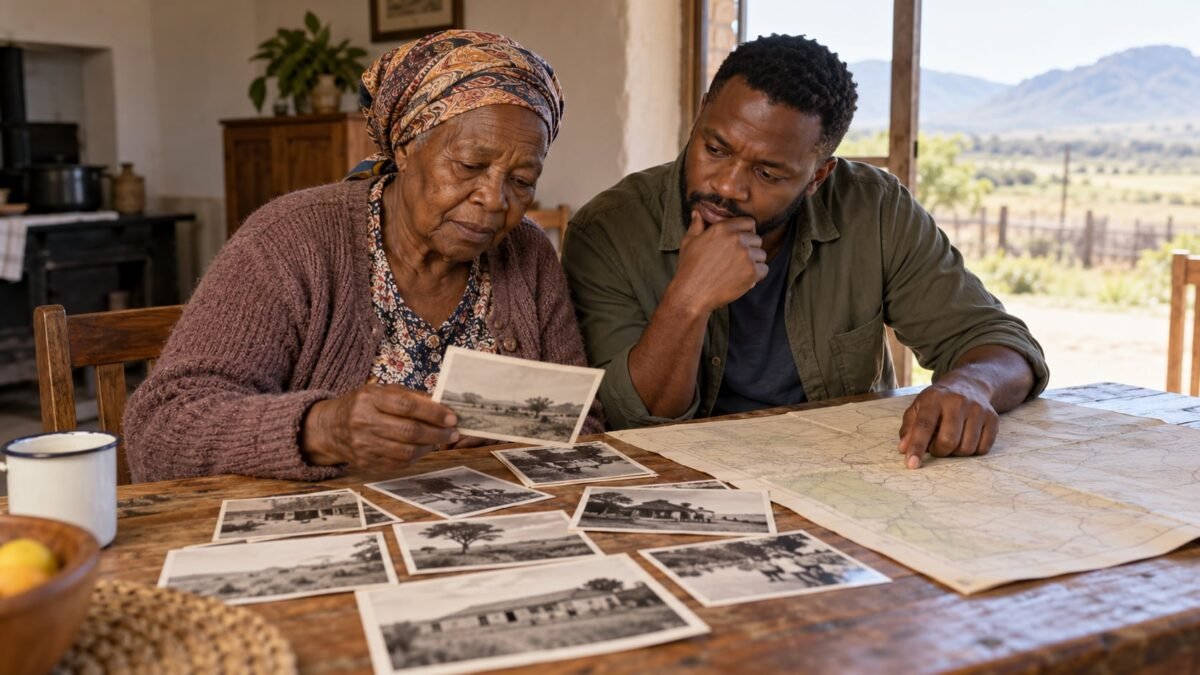
A family remembers land from which grandparents were removed. Somebody has an old photograph, another person remembers a farm name and a relative says a claim was lodged years ago. The first useful step is to establish the legal and factual starting point, rather than paying someone who promises an immediate land allocation.
South Africa’s restitution process concerns dispossession of rights in land through past racially discriminatory laws or practices. It is not a general scheme under which anybody who wants land can submit an application for ownership.
Understand the statutory basis
The Restitution of Land Rights Act provides the framework for restitution, including dispossession after 19 June 1913 through racially discriminatory laws or practices. Eligibility also concerns the person or community with the right and the claim. Compensation already received and other statutory exclusions can also matter.
The process is not confined to registered owners. Historical rights and occupation can require careful investigation. A family should therefore collect the evidence it has rather than assuming that the absence of a title deed ends the enquiry.
Equally, a remembered connection with a place is not proof that every descendant has a separate claim. Identify the original right, the person dispossessed and the basis on which the present family or community says it is entitled to pursue restitution.
The lodgement window is a central issue
The original lodgement deadline was 31 December 1998. Legislation reopening claims in 2014 was declared invalid by the Constitutional Court in the LAMOSA litigation because of defective public participation. Claims lodged during the reopening period have a legally distinct position.
The judiciary’s LAMOSA reports page records the continuing court supervised context. The 2019 Constitutional Court judgment deals with the treatment of later claims and priority for older claims.
There is no verified generally reopened window on which this article can advise a family to lodge a fresh claim today. Do not follow an old notice inviting claims until June 2019 as though it were a current invitation. Ask the Commission to confirm the present legal position before acting.
An existing later claim is not the same as a new application
A claim already lodged during the 2014 to 2016 period should not simply be treated as though it never existed. Its investigation and processing are affected by the relevant court orders and the position of older claims.
A May 2026 Land Court judgment illustrates the continuing importance of those orders. Families need advice about their actual claim and region rather than a general assurance that all later claims are now being processed.
If a relative has a lodgement receipt, preserve it. Record the reference number, date, claimant name and land description. A receipt is evidence of lodgement; it is not necessarily proof that the claim has been validated or that a particular remedy will follow.
Start by tracing the claim file
Ask the relevant regional office of the Commission on Restitution of Land Rights whether a claim exists. Provide the claimant’s name, reference number if known, land description and approximate lodgement date. Explain whether you are the claimant, an authorised representative or a descendant seeking information.
Request written confirmation of the current status and the next step. A useful answer identifies whether the matter is awaiting research, has been accepted for further processing, is disputed or has reached another stage. A general statement that it is “with the department” is difficult to follow up.
Keep copies of each enquiry and response. If the person who lodged the claim has died, ask what documents are needed to update representation and contact details. Do not assume that changing a family contact also changes the legal claimant.
Build the family and land history carefully
Collect birth, marriage and death records where relevant, along with old correspondence, compensation records, photographs and any deeds or tenancy documents. Write down oral histories while people who remember the events can still explain them.
Separate direct recollection from information heard from someone else. If a relative remembers the location but not the official description, record landmarks and possible names. A survey or deeds investigation may later help connect those details with formal land records.
Avoid changing the story to fit what someone says is a stronger claim. Conflicting dates should be identified and investigated. Honest uncertainty can be resolved through research; a deliberately false affidavit can damage the entire matter.
Representation must be clear
Where a community or extended family is involved, agree who may communicate and what authority they hold. Keep meeting records and explain significant decisions to affected members. A person holding the paperwork should not automatically be treated as entitled to settle everybody’s rights.
For example, a relative may be authorised to obtain progress reports but not to accept compensation or sign a settlement. Those are different powers. Ask for advice before signing a mandate that gives broad authority without clear reporting duties.
Be cautious about paying a person who promises to put a claim ahead of others. Verify their identity, professional role and written fee arrangement. Official references and genuine research are more valuable than assurances about personal connections.
Restitution and other land issues should not be confused
A restitution claim does not automatically permit entry onto land, occupation, eviction of current occupants or the removal of fences. Existing ownership and occupation disputes require lawful processes.
Other land reform, tenure or housing programmes may be relevant to a household even where a fresh restitution claim cannot be lodged. Ask the appropriate department which route fits the actual need. Do not rebrand a housing application as a restitution claim simply because the word sounds more promising.
A productive first step is a verified record
For many families, the immediate task is to find the existing claim, establish who represents it and understand the stage it has reached. Where no claim was lodged, obtain current advice about the closed lodgement position and any other appropriate route.
Preserve the history, but connect it with the official record. That gives the family a sound basis for asking questions and protects it from people who sell certainty that the law and process do not provide.
Related reading: Land, Agriculture & Rural Development; Farm occupiers’ rights when a job ends or the land is sold; Expropriation Act: has the new law come into force?.